





The mystery clock was invented in the 19th century by the illusionist Jean-Eugène Robert-Houdin. It was later developed exclusively for Cartier by the watchmaker Maurice Couët. A fascinating object, the hands appear to float like magic within the crystal, unconnected to any mechanism. Mystery clocks require months of patient work before they are lavishly decorated by the jeweller. They remain among the most exceptional examples of Cartier’s timepiece production. The first example was the Model A, a dual vertical axle rock crystal clock produced in 1912. In the 1920s, Maurice Couët developed several versions of the mystery clock, including twelve with Chinese origins and six with the "Portique" (Portico) structure. These have remained the most expensive decorative objects ever produced by Cartier.
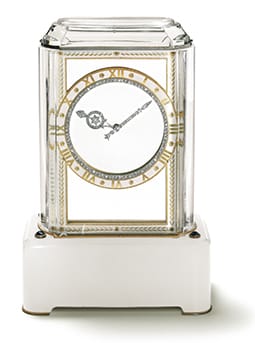
MODEL A MYSTERY CLOCK
CARTIER PARIS, 1914
Platinum, yellow gold, rock crystal, white agate (base), four sapphire cabochons, rose-cut diamonds, white enamel. Particularly rare, this clock is one of the very first mystery clocks created by Cartier.
Sold to Count Greffulhe, husband to the famous Countess Greffulhe, “the most beautiful woman in Europe” according to Marcel Proust, who partly modelled his character of the Duchess de Guermantes on her.
Height 13.0 cm
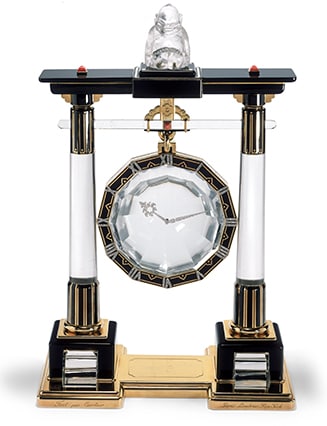
LARGE PORTIQUE
MYSTERY CLOCK
CARTIER PARIS, 1923
Yellow gold, platinum, rock crystal, rose-cut diamonds, onyx, coral cabochons, black enamel
Square, 8-day double-barrel movement, gold-plated, 13 jewels, bimetallic balance, Breguet balance spring.
This clock was the first in a series of six in the form of a Shinto “shrine gate” (portique), all different and all made by Cartier between 1923 and 1925.
Sold to Mrs H.F. McCormick, Ganna Walsk (1887-1984), the opera singer of Polish origin.
Like Daisy Fellowes and Mona Bismarck, Walska was one of the select group of fashion icons of her day. With unerring taste, she assembled a remarkable collection of jewellery, showing a marked preference for Cartier.
35 x 23 x 13 cm
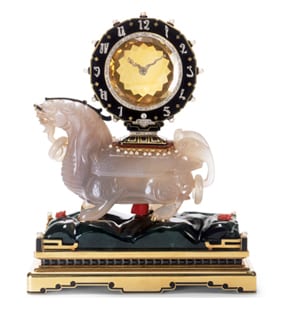
CHIMERA MYSTERY
CLOCK
CARTIER NEW YORK, 1926
Yellow gold, platinum, citrine (dial), agate (chimera), nephrite (waves), rose-cut diamonds, natural pearls, emerald cabochons, onyx, coral, red and black enamel
Rectangular 8-day movement, gold-plated, 15 jewels, bimetallic balance, Breguet balance spring.
The agate chimera, of Chinese origin, dates from the 19th century. This mystery clock was the 6th in a series of 12 that featured animals or figurines, made between 1922 and 1931, partly inspired by Louis XV and Louis XVI clocks in which the movement was set on the back of an animal.
Height 17.0 cm
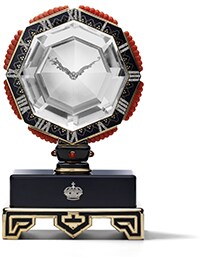
MYSTERY CLOCK WITH SINGLE AXLE
CARTIER PARIS, 1927
Yellow gold, platinum, rock crystal, obsidian (base), ebonite (platform), rose-cut diamonds, onyx, coral, black enamel.
Rectangular 8-day movement, gold-plated, 13 jewels, Swiss lever escapement, bimetallic balance, Breguet balance spring.
Provenance: Queen Victoria Eugenia of Spain, wife of Alphonse XIII.
Height 13.90 cm
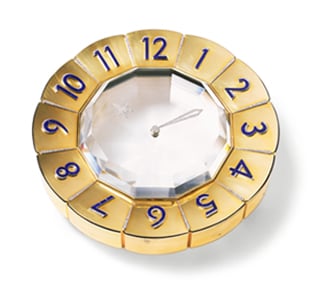
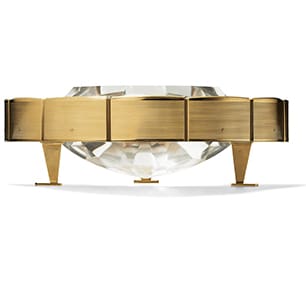
PLATE MYSTERY CLOCK
CARTIER PARIS, 1953
Yellow gold, platinum, rock crystal, brilliant- and single-cut diamonds, lapis lazuli.
Circular 8-day double-barrel movement, gold-plated, Swiss lever escapement, bimetallic balance, Breguet balance spring.
Hour indicator in the shape of a star.
Diameter 23.8 cm


